
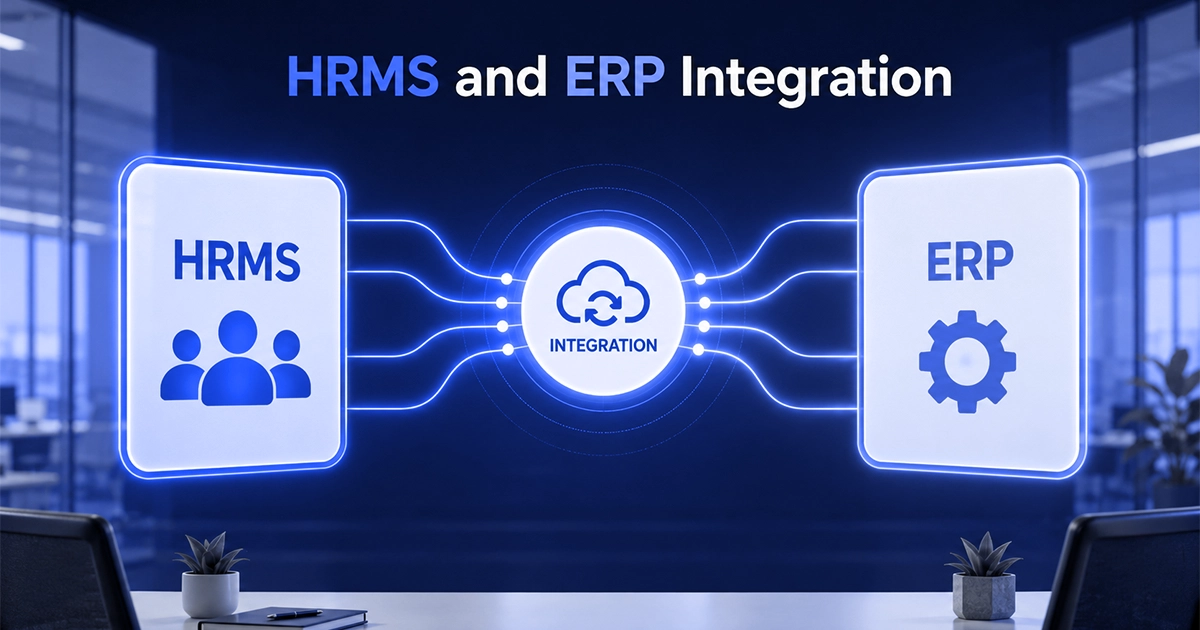
A GCC business can run a modern HRMS and a capable ERP, yet still struggle every month if payroll data does not move cleanly between HR and finance.
HR may manage employee records, attendance, leave, salary changes, overtime, and approvals. Finance may manage cost centres, payroll posting, accounting entries, budget reports, and management dashboards. If these records remain separate, both teams spend every payroll cycle checking files, correcting differences, and explaining numbers after the fact.
This is why HRMS and ERP integration is becoming more important for companies across Saudi Arabia, Bahrain, and the UAE.
Connected payroll data is not only about sending salary values from one system to another. It is about connecting employee records, payroll cycles, attendance, approvals, accounting entries, compliance workflows, and reporting so HR and finance can work from one controlled flow of information.
Key Takeaways
- Payroll is both an HR process and a finance process. HR owns employee and payroll inputs, while finance owns accounting, cost centres, cash flow, and financial reporting.
- When HRMS and ERP are disconnected, businesses often face duplicate employee records, manual payroll reconciliation, delayed cost reports, weak audit trails, and finance posting errors.
- HRMS and ERP integration helps connect payroll, attendance, leave, salary changes, approvals, cost allocation, and accounting entries.
- GCC businesses in Saudi Arabia, Bahrain, and the UAE should plan payroll integration around local workforce, wage, payroll, compliance, and reporting requirements.
- Aramis Solutions helps businesses connect QuickHCM HRMS with ERP, finance, payroll, reporting, and workforce workflows through integration planning, data cleanup, implementation support, and post-go-live improvement.
Summary
Payroll accuracy depends on more than salary calculation. It depends on clean employee records, correct attendance, approved leave, updated salary components, cost centre mapping, accounting rules, and timely finance posting.
When HRMS and ERP systems are disconnected, payroll becomes a monthly reconciliation exercise. HR prepares files, finance checks numbers, managers approve changes manually, and leadership may still not have a reliable view of workforce cost by branch, department, project, or business unit.
This guide explains why GCC finance and HR teams need connected payroll data, what HRMS controls, what ERP controls, where integration improves accuracy, and how Aramis Solutions supports HRMS and ERP integration across Saudi Arabia, Bahrain, and the UAE.
Why Do GCC Finance and HR Teams Need Connected Payroll Data?
GCC finance and HR teams need connected payroll data because salaries, attendance, leave, employee records, allowances, deductions, cost centres, approvals, and accounting entries all affect financial accuracy. HRMS and ERP integration reduces manual reconciliation, payroll errors, delayed reports, and audit risk by connecting HR data with finance workflows.
The goal is not only system integration. The goal is better payroll control, cleaner reporting, stronger audit visibility, and more reliable workforce cost management.
Why Payroll Data Cannot Stay Separate from Finance
Payroll is usually one of the largest recurring costs in a business.
It affects cash flow, budgets, project costing, department reporting, financial close, and management decisions. If HRMS records and ERP finance data are disconnected, finance teams may not see payroll cost accurately until late in the cycle.
HR may approve salary changes, attendance corrections, overtime, deductions, or leave adjustments. But if finance is still working from exported files or old salary sheets, errors can enter accounting reports quickly.
This creates practical problems:
- Payroll values may not match finance postings
- Cost centres may be missing or outdated
- Salary changes may not reach finance on time
- Attendance adjustments may be checked manually
- Overtime and deductions may need repeated reconciliation
- Finance may not see payroll cost by department, branch, or project
- Audit evidence may be spread across files, emails, and system exports
- For Saudi Arabia, this matters when payroll, GOSI, Qiwa, Mudad, WPS, cost allocation, and finance posting need to stay aligned.
- For Bahrain, HR and finance integration can reduce repeated checks around WPS payroll workflows and reporting.
- For UAE businesses, connected payroll systems can support clearer workforce cost visibility across entities, branches, and departments.
This is why payroll integration should be planned as a business-control project, not only a software connector.
Common Problems When HRMS and ERP Are Disconnected
Disconnected HRMS and ERP systems create repeated payroll checks, duplicate employee records, delayed cost reports, approval gaps, finance posting errors, and weak audit trails.
When systems do not connect, the same data is often handled more than once. Employee records may exist in HRMS, payroll files, ERP finance records, and spreadsheets. Each copy increases the risk of mismatch.
Over time, teams may stop trusting system reports and build manual trackers instead.
Common problems include:
- Manual payroll reconciliation between HR, payroll, and finance files
- Duplicate employee records across HRMS and ERP finance systems
- Payroll errors caused by late attendance, leave, or salary updates
- Delayed reports on workforce cost by branch, department, or cost centre
- Weak approval trails for salary changes, overtime, deductions, or allowances
- Accounting entries that do not match payroll records without manual checking
- Compliance risk when payroll, employee, and finance data are not aligned
- Poor audit readiness because evidence is spread across emails and spreadsheets
These issues affect growing GCC companies because payroll is never just an HR task. It is also a finance, compliance, and reporting concern.
When payroll remains disconnected, HR becomes responsible for repeated explanation, finance becomes responsible for repeated checking, and leadership receives reports later than needed.
What HRMS Controls vs What ERP Controls
Before integration begins, HR and finance teams need to agree which system owns which data.
If both systems edit the same employee or payroll fields without clear rules, integration can create more confusion instead of control.
A clean ownership model helps HRMS and ERP integration work properly.
What HRMS Controls
HRMS usually controls people data and payroll inputs.
A system such as QuickHCM HRMS can support employee profiles, job details, salary structures, attendance, leave, overtime, deductions, allowances, onboarding, document records, HR approvals, and workforce reporting.
HRMS should usually be the source of truth for:
- Employee records
- Job titles and departments
- Salary components
- Attendance
- Leave balances
- Overtime
- Allowances and deductions
- HR approvals
- Employee documents
- Payroll preparation data
- Workforce reports
This matters because payroll depends on employee activity. If employee records, attendance, leave, or salary components are inaccurate, payroll and finance reporting will also be affected.
For businesses preparing HRMS implementation or integration, Aramis Solutions’ guide on cleaning employee records before HRMS migration explains why data quality should be handled before go-live.
What ERP Controls
ERP usually controls finance, accounting, cost centres, project costing, budgets, cash flow, payroll posting, approvals, audit records, and management reporting.
A system such as PACT ERP can support finance, operations, reporting, inventory, procurement, approvals, cost visibility, and business performance tracking.
ERP should usually control:
- Chart of accounts
- Cost centres
- Project codes
- Accounting entries
- Budget allocation
- Cash flow impact
- Payroll posting
- Financial approvals
- Audit records
- Management dashboards
- Department and branch reporting
Once payroll is reviewed and approved, ERP should reflect the correct financial impact. If payroll is posted manually, errors can move directly into finance reports.
The Aramis guide on ERP financial controls CFOs need for audit-ready reporting supports this wider point: payroll data affects financial control, cost allocation, and management reporting, not only HR administration.
Where Payroll Sits Between HR and Finance
Payroll sits between HRMS and ERP because HR owns the employee information, while finance owns the accounting impact.
This is why payroll is one of the most important integration points between the two systems.
A basic payroll-to-finance data flow may look like this:
- HRMS stores employee master data.
- Attendance, leave, overtime, allowances, and deductions are reviewed.
- Payroll values are calculated and approved.
- Finance receives approved payroll values.
- ERP posts payroll into accounting and cost centres.
- Management reports show workforce cost by department, branch, project, or business unit.
If this flow is manual, every stage creates room for delay or error.
If the flow is controlled through integration, payroll becomes easier to validate, post, report, and audit.
What Happens When HRMS and ERP Are Integrated
Integrated HRMS and ERP systems improve payroll accuracy, reduce manual work, connect employee cost to finance, strengthen audit trails, and give leaders clearer workforce cost visibility.
When systems are connected properly, payroll becomes easier to control.
HR updates employee data in HRMS. Attendance, leave, overtime, and payroll inputs are reviewed before processing. Approved payroll values then connect with ERP for finance posting, cost allocation, and reporting.
This reduces the need for manual export-import cycles.
The business benefits include:
- Fewer duplicate entries
- Faster payroll reconciliation
- Cleaner approval trails
- Better workforce cost reporting
- More accurate finance posting
- Stronger audit readiness
- Reduced month-end pressure
- Better visibility for CFOs, HR Directors, and Operations Heads
Finance can see salary cost by department, branch, project, or cost centre more reliably. HR can reduce repeated questions from finance because approved payroll data is already structured.
Leadership can make decisions using reports that are easier to trust.
This is also where integration supports the wider enterprise system strategy discussed in Aramis Solutions’ guide on ERP, CRM, and HRMS integration in GCC enterprises.
GCC Compliance Use Cases for Payroll Integration
GCC payroll integration supports compliance by helping HR and finance align employee records, salary processing, statutory workflows, audit trails, wage files, and workforce reporting.
Businesses should always verify current obligations with official sources and qualified advisers. However, from a systems perspective, the need is clear: payroll records, employee records, approvals, finance posting, and reporting should not sit in disconnected files.
Practical GCC compliance use cases include:
Saudi Arabia
In Saudi Arabia, payroll and workforce processes may involve GOSI, Qiwa, Mudad, WPS-related salary workflows, employee contracts, workforce records, payroll approvals, and finance posting.
Connected payroll data can help businesses align employee records, salary components, approval evidence, and payroll cost visibility.
For Saudi-specific HRMS context, Aramis Solutions’ guide on QuickHCM HRMS Saudi Arabia: GOSI and Qiwa Ready provides related implementation guidance.
Bahrain
In Bahrain, HR and finance teams often need better control over WPS-related payroll preparation, employee records, salary files, finance reports, and audit evidence.
Integration can help reduce manual checking before payroll submission or reporting.
Aramis Solutions also covers this in its article on HRMS software in Bahrain and WPS compliance.
UAE
In the UAE, connected payroll systems can support wage processing, employee master data accuracy, workforce reporting, and branch or entity-level payroll visibility.
For UAE businesses with multi-location or multi-entity operations, the value is not only payroll processing. It is the ability to see workforce cost clearly and consistently.
Regional GCC Groups
For companies operating across more than one GCC market, integration can help standardize:
- Payroll cost centres
- Department reporting
- Approval rules
- Employee master data
- Workforce dashboards
- Finance posting structures
- Audit evidence
Across all markets, the goal is the same: give HR and finance one controlled flow of employee, salary, approval, cost, and accounting data.
Integration Checklist for HR and Finance Teams
A payroll integration project should not begin with only technical connectors. It should begin with data, process, ownership, and reporting decisions.
Before integration starts, HR and finance teams should prepare:
- Employee master data ownership
- Clean employee records
- Job titles and department fields
- Salary components
- Bank details
- Attendance rules
- Leave policies
- Overtime rules
- Allowances and deductions
- Payroll cycles and cut-off dates
- Cost centres
- Branch codes
- Project codes
- Accounting mappings
- Approval rules
- Exception handling
- User access rights
- Compliance requirements
- Reporting requirements
- Testing scenarios
- Post-go-live support ownership
This readiness work reduces rework during implementation and makes testing more realistic.
For example, if cost centres are not mapped properly before integration, payroll may post into finance but still fail to support useful reporting. If attendance policies are unclear, payroll errors may still happen even after systems are connected.
This is why integration planning should include HR, payroll, finance, IT, and management stakeholders.
Reporting Questions to Answer Before Integration
Before HRMS and ERP are connected, leadership should define what reports the integration should support.
Useful questions include:
- What payroll cost should finance see by department?
- What should be reported by branch, project, or cost centre?
- Which salary components should appear in finance reports?
- Which payroll adjustments require approval evidence?
- Which employee changes should affect payroll and accounting?
- What does the CFO need after payroll is closed?
- What does the HR Director need before payroll is processed?
- What does operations need to understand workforce cost and capacity?
- What reports should be available monthly without manual preparation?
These questions help integration become measurable.
A connector that moves data is useful. A connector that improves reporting confidence is much more valuable.
How Aramis Solutions Helps Connect HRMS and ERP Systems
Aramis Solutions helps GCC businesses connect HRMS and ERP systems through QuickHCM, PACT ERP, payroll workflow planning, finance integration, compliance alignment, data cleanup, reporting design, and post-launch support.
The goal is not only to connect two applications. The goal is to improve payroll accuracy, cost visibility, compliance readiness, and reporting control.
This matters because payroll mistakes affect employees, finance reports, audit evidence, and leadership trust.
Integration Advisory Before Implementation
Before implementation, Aramis Solutions helps define payroll data ownership, finance posting rules, compliance requirements, cost centre mapping, reporting needs, and user responsibilities across HR and finance.
The team starts by reviewing how payroll currently moves from HR to finance.
This may include:
- Where employee data is stored
- How attendance is approved
- How salary changes are handled
- How payroll is calculated
- How finance receives payroll values
- How payroll is posted into ERP
- How cost centres are mapped
- How reports are prepared
- Where manual checks happen
- Which errors repeat every month
This advisory step reduces the risk of building the wrong connection.
A business may think it only needs payroll export, but later discover that it also needs cost centre mapping, approval evidence, audit reporting, and finance posting rules.
Aramis Solutions helps define these details early so implementation supports both HR and finance.
Payroll, Finance, and Compliance Workflow Support
Aramis Solutions supports payroll, finance, and compliance workflows by connecting HRMS data with ERP posting, reporting, approvals, dashboards, and regional payroll requirements across GCC businesses.
- For Saudi businesses, Aramis Solutions can support integration planning around QuickHCM, ERP, finance systems, GOSI and Qiwa-related workforce processes, Mudad/WPS-related workflows, and payroll reporting.
- For Bahrain businesses, Aramis Solutions can support HRMS, payroll, WPS-related workflows, finance reporting, and audit preparation.
- For UAE businesses, Aramis Solutions can support connected payroll systems, employee data accuracy, finance reporting, and multi-entity workforce visibility.
When standard connectors are not enough, Aramis Solutions can also support custom development, APIs, dashboards, and workflow layers to connect HRMS, ERP, finance, and reporting systems.
Related Aramis Solutions Resources
For deeper reading before planning HRMS and ERP integration, explore these related resources:
- QuickHCM HRMS
- PACT ERP Solutions
- ERP Financial Controls CFOs Need for Audit-Ready Reporting
- Clean Employee Records Before HRMS Migration
- QuickHCM HRMS Saudi Arabia: GOSI and Qiwa Ready
- HRMS Software Bahrain and WPS Compliance
- ERP, CRM & HRMS Integration in GCC
- Custom Development Services
Final Thoughts
Payroll is too important to sit between disconnected systems.
HR owns employee and payroll inputs. Finance owns accounting and cost reporting. Leadership needs accurate workforce cost visibility. When these groups work from separate files, the business increases the risk of errors, delays, weak audit trails, and poor reporting confidence.
For GCC companies, HRMS and ERP integration is a practical step toward better payroll accuracy and financial control.
Connected payroll data can help reduce manual reconciliation, align HR and finance records, improve audit readiness, and give leadership clearer visibility into workforce cost.
Aramis Solutions helps GCC businesses connect HRMS and ERP systems so payroll, finance, and workforce data work together with better accuracy and control.
To review your payroll, HRMS, ERP, or finance integration roadmap, contact Aramis Solutions for a consultation.
FAQs
HRMS and ERP integration connects employee, payroll, attendance, leave, salary, approval, and finance data between HRMS and ERP systems. The goal is to reduce manual reconciliation and make payroll cost visible in finance reports. In GCC businesses, HR usually owns employee data while ERP manages accounting, cost centres, and financial reporting.
Payroll data should connect with ERP finance systems because salaries, allowances, deductions, overtime, and employee cost affect accounting, budgets, cash flow, and management reports. Without integration, finance teams may rely on spreadsheets and manual entries. Connected HRMS and ERP workflows help payroll data move into finance with better accuracy, timing, and audit visibility.
HRMS ERP integration improves payroll accuracy by reducing duplicate entry, aligning employee records with payroll values, connecting approval rules, and posting approved payroll data into finance systems. It helps teams detect mismatches earlier, especially around attendance, leave, overtime, deductions, and salary changes.
Yes. HRMS integration can support GCC compliance by improving employee data accuracy, payroll traceability, approval evidence, and reporting. In Saudi Arabia, connected systems can support stronger payroll-to-finance visibility around GOSI, Qiwa, and wage-related workflows. In Bahrain and the UAE, integration can support wage reporting, audit checks, and workforce cost control when configured properly.
Businesses should clean employee names, IDs, departments, job titles, salary components, bank details, cost centres, branch codes, leave balances, attendance rules, allowances, deductions, and approval ownership before integration. If poor data is integrated, the business may simply move errors faster between HR and finance systems.
HRMS should usually be the source of truth for employee records, attendance, leave, salary components, and payroll inputs. ERP should usually be the source of truth for finance posting, accounting entries, cost centres, budget reports, and management dashboards. Integration should define clearly which system owns each data point.
Aramis Solutions helps by assessing payroll workflows, cleaning employee records, mapping cost centres, connecting QuickHCM with ERP or finance systems, defining approval rules, supporting compliance workflows, and building dashboards. The team treats HRMS and ERP integration as a business-control project that helps finance and HR teams improve payroll accuracy, reporting, and audit readiness.