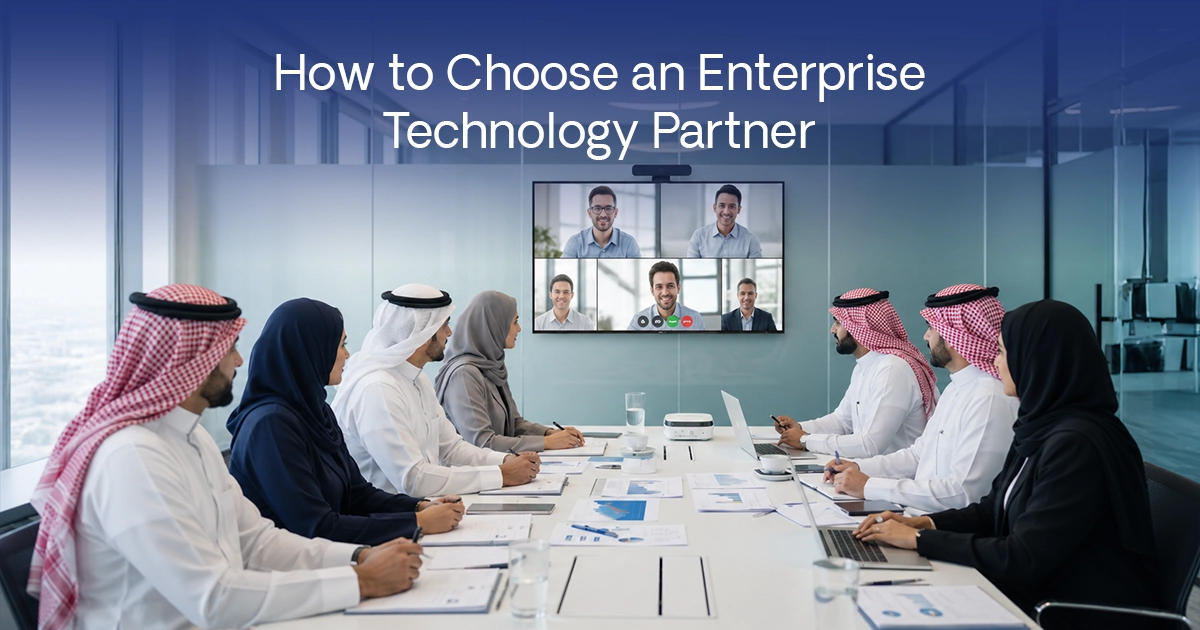
Choosing an enterprise technology partner in the GCC is not the same as buying software.
A company in Saudi Arabia may need ERP, ZATCA-aware finance workflows, SAP consulting, Microsoft solutions, cybersecurity, and system integration. A Bahrain business may need WPS-ready HRMS, reporting, and custom workflow support. A UAE enterprise may need AI automation, cloud collaboration, customer-facing systems, and stronger data governance.
In each case, the real risk is not choosing the wrong software alone. The bigger risk is choosing a partner that does not understand how the business actually operates.
A strong enterprise technology partner should understand business processes before recommending software, support multiple enterprise systems, know GCC compliance requirements, connect platforms, protect data, and stay involved after go-live. The right partner helps businesses implement ERP, SAP, HRMS, AI, cybersecurity, ITSM, Microsoft solutions, and custom systems with long-term operational value.
Key Takeaways
- The right enterprise technology partner should understand the business before recommending software.
- GCC businesses should evaluate partners based on process knowledge, implementation capability, compliance awareness, integration skill, cybersecurity maturity, and post-go-live support.
- A software vendor may provide the product, but an implementation partner helps the business make the system work in real operations.
- For Saudi Arabia, Bahrain, and the UAE, local compliance, payroll, finance, cybersecurity, and reporting requirements should shape technology decisions.
- Aramis Solutions supports GCC businesses across PACT ERP, QuickHCM HRMS, SAP, Microsoft 365, Smart Service Desk ITSM, Artificial Intelligence, Cyber Security, Custom Development, and enterprise implementation support.
Summary
GCC businesses are investing in ERP, HRMS, SAP, Microsoft solutions, AI, cybersecurity, ITSM, custom development, and digital transformation. But technology value depends heavily on the partner behind the implementation.
A platform can have strong features and still fail if business processes are not mapped, users are not trained, systems are not integrated, or reports do not answer leadership’s real questions. This is why companies in Saudi Arabia, Bahrain, and the UAE need a practical checklist before selecting an enterprise technology partner.
This guide explains what buyers should evaluate before choosing a partner, including business process understanding, multi-service capability, GCC compliance knowledge, integration experience, cybersecurity awareness, implementation quality, and post-go-live support.
What Makes a Good Enterprise Technology Partner in the GCC?
A good enterprise technology partner in the GCC understands business workflows before recommending software, supports multiple enterprise systems, knows local compliance requirements, connects platforms, protects data, trains users, and provides support after go-live. The right partner helps companies turn ERP, HRMS, SAP, Microsoft, AI, cybersecurity, ITSM, and custom solutions into measurable business value.
The strongest partner is not always the one with the largest product list. It is the one that can translate business requirements into systems that teams can use, managers can trust, and leadership can scale.
Why the Right Technology Partner Matters More Than the Software Alone
Software value depends on implementation quality, user adoption, integration, reporting, and long-term support.
Many GCC businesses already own good software but still struggle with manual work. ERP may not connect with HRMS. Finance may still ask for spreadsheets. Microsoft 365 may be used only for email instead of workflow improvement. Cybersecurity may be reviewed after implementation instead of during planning. Leadership dashboards may look impressive but fail to answer real management questions.
These are not always software problems. They are often partner-selection problems.
A capable enterprise solutions partner looks beyond installation. The partner should ask:
- How do approvals work today?
- Which teams own the data?
- Where does reporting break down?
- Which compliance requirements affect the system?
- Which workflows are still managed manually?
- What should leadership be able to see after go-live?
- Which systems need to connect now and later?
- For an enterprise technology partner in Saudi Arabia, this may include ZATCA-aware finance workflows, GOSI and Qiwa-related workforce needs, ERP controls, and cybersecurity expectations.
- For an IT solutions partner in Bahrain, it may include WPS payroll workflows, leaner teams, finance visibility, and practical reporting.
- For a digital transformation partner in the UAE, it may include cloud adoption, AI readiness, multi-entity operations, and data governance.
A partner that only sells licenses may complete a deployment. A partner that understands operations can help improve how the business runs.
Checklist Item 1: Business Process Understanding
The partner should map business processes before recommending tools.
If discovery is weak, the project may automate the wrong workflow, duplicate old problems, or create a system users avoid after launch.
A serious technology partner begins with discovery. This means reviewing finance processes, HR workflows, sales handovers, approval routes, service operations, reporting gaps, customer journeys, and operational pain points before recommending a solution.
A partner that recommends software in the first meeting without asking process questions is unlikely to build a system that fits the business.
- For Saudi Arabia, process understanding may include finance controls, invoicing workflows, multi-branch reporting, workforce processes, and cybersecurity governance.
- For Bahrain, it may include WPS payroll needs, practical reporting, HR workflows, and branch-level finance visibility.
- For the UAE, it may include cloud workflows, AI adoption, analytics readiness, customer systems, and multi-entity reporting.
This is where an enterprise solutions provider should act as a consultant, not just a reseller.
The right partner should identify:
- What should remain standard
- What needs configuration
- What needs integration
- Where custom development is justified
- Which workflows should change after go-live
- Which reports must be trusted from day one
An ERP implementation partner should not only explain how the software will be configured. It should explain how the business will operate better after implementation.
Checklist Item 2: Multi-Service Enterprise Capability
GCC businesses should prefer partners that can support connected enterprise needs, not only one isolated platform.
A single-system vendor may solve one problem but create another gap. Many businesses need finance, HR, service, customer operations, analytics, cybersecurity, and reporting to work together. This is why a broader technology partner can be more useful than a narrow implementation vendor.
A strong partner should be able to support:
- ERP and finance platforms such as PACT ERP
- SAP advisory and implementation support
- Microsoft productivity, collaboration, and reporting through Microsoft 365
- HR and payroll workflows through QuickHCM HRMS
- IT service management through Smart Service Desk ITSM
- AI automation through Artificial Intelligence solutions
- Cybersecurity planning through Cyber Security services
- Portals, integrations, workflow automation, and Custom Development
- Customer-facing systems, contact center workflows, ecommerce, and mobile applications where relevant
This matters because most businesses do not need more disconnected tools. They need a connected enterprise ecosystem.
A good partner should understand how ERP connects with HRMS, how payroll connects with finance, how Microsoft 365 supports collaboration, how AI depends on clean data, how cybersecurity protects system access, and how reporting connects leadership with daily operations.
Checklist Item 3: GCC Compliance Knowledge
A technology partner should understand regional compliance because ERP, HRMS, payroll, cybersecurity, invoicing, VAT, corporate tax, and audit requirements affect how systems are designed.
Compliance is not a small configuration detail. It affects data structure, approvals, user roles, audit trails, payroll workflows, invoice handling, access control, and reporting.
A partner that lacks GCC compliance awareness may build a technically working system that still creates operational or audit risk.
- For Saudi Arabia, a partner should understand areas such as ZATCA e-invoicing, GOSI, Qiwa, VAT, NCA cybersecurity expectations, and finance control requirements.
- For Bahrain, it should understand payroll, WPS-related workflows, VAT, audit readiness, and practical HR finance reporting.
- For the UAE, it should consider VAT, corporate tax, payroll reporting, cloud operations, data governance, and multi-entity workflows.
This is especially important when implementing ERP, HRMS, SAP, Microsoft systems, cybersecurity controls, or custom business applications.
An enterprise solutions provider should consider compliance and security together. A system that improves productivity but weakens control is not a complete solution.
Checklist Item 4: Integration and Customization Capability
Integration capability matters because disconnected ERP, HRMS, finance, service, reporting, and customer-facing systems create manual work, duplicated data, delayed decisions, and weak visibility.
A GCC business may start with one platform, then add more tools over time. Without integration, each department creates its own version of the truth.
Sales or customer teams may work in one system. Finance may work in ERP. HR may use HRMS. IT may use an ITSM platform. Leadership may wait for manually prepared dashboards. The result is a business with many tools but limited visibility.
The right partner should know how to connect systems through:
- APIs
- Middleware
- Custom dashboards
- Reporting layers
- Workflow automation
- Customer portals
- Supplier portals
- Employee self-service portals
- Microsoft 365 workflows
- ERP, HRMS, and finance integrations
Customization should also be handled carefully.
A good partner does not customize everything just because it can. It customizes where standard tools cannot support important workflows. The partner should explain when configuration is enough, when integration is needed, and when custom development makes business sense.
This is also where custom software should support the enterprise roadmap, not create another disconnected system.
Checklist Item 5: Implementation and Post-Go-Live Support
Enterprise technology projects succeed after go-live, not on launch day.
Many projects look complete when the system goes live. The real test begins when users enter transactions, managers review dashboards, finance closes the first month, HR processes payroll, and leadership asks for reliable reports.
If users are not trained, reports are unclear, or support is slow, teams may return to spreadsheets.
A reliable implementation partner should provide:
- Implementation planning
- Data migration support
- User role design
- Testing and validation
- Workflow configuration
- Report and dashboard setup
- User training
- Adoption support
- Issue handling after launch
- Post-go-live improvement
The partner should also define success measures before launch.
These may include:
- Reduced manual reporting
- Faster approvals
- Cleaner payroll processing
- Shorter finance close cycles
- Better branch visibility
- Better service response time
- Stronger access control
- More reliable leadership dashboards
Go-live is not the finish line. It is the point where the business starts testing whether the implementation was designed properly.
Checklist Item 6: Cybersecurity and Data Governance Awareness
Enterprise systems hold financial, customer, employee, payroll, supplier, and operational data. Cybersecurity and data governance must be part of the project from the first planning stage.
Security cannot be added as an afterthought.
ERP contains financial records. HRMS contains employee data. Customer-facing systems contain client information. AI and analytics tools may process sensitive operational data. Microsoft 365 may hold documents, approvals, and internal communication. Custom applications may connect several business workflows.
A mature technology partner should review:
- User roles
- Privileged access
- Approval controls
- Audit logs
- Backup requirements
- Data ownership
- Integration security
- Cybersecurity responsibilities
- Reporting access
- Post-go-live monitoring
Through Cyber Security services, Aramis Solutions helps businesses consider risk alongside implementation. This strengthens system trust and protects long-term value.
A system should not only work. It should be secure, governed, and reliable.
Evaluation Table
A structured evaluation table helps buyers compare partners on business understanding, service breadth, compliance knowledge, integration capability, cybersecurity awareness, and post-go-live support.
| Evaluation Area | What to Check | Why It Matters |
| Business discovery | Does the partner study workflows before recommending tools? | Prevents poor-fit implementation |
| Service breadth | Can they support ERP, HRMS, SAP, Microsoft, AI, cybersecurity, ITSM, and custom systems? | Reduces vendor fragmentation |
| GCC compliance | Do they understand ZATCA, WPS, GOSI, Qiwa, VAT, NCA, payroll, and audit needs? | Protects control and reporting |
| Integration | Can they connect ERP, HRMS, finance, Microsoft, reporting, and service systems? | Reduces manual work |
| Cybersecurity | Do they plan access, governance, and data protection early? | Reduces system risk |
| Implementation | Do they manage migration, testing, training, and user adoption? | Improves launch quality |
| Post-go-live support | Do they support reporting and workflow improvement after launch? | Improves long-term value |
This table helps buyers compare partners beyond price.
A cheaper partner may cost more later if implementation is weak, systems remain disconnected, or users do not adopt the platform.
Red Flags When Choosing a Technology Partner
Red flags include software-only selling, weak discovery, poor compliance awareness, no integration roadmap, unclear cybersecurity planning, limited training, and no structured post-go-live support.
Buyers should be cautious when a partner focuses only on licenses, demos, or quick deployment without asking operational questions.
A polished presentation does not prove implementation maturity.
Watch for these warning signs:
- The partner recommends software before understanding business processes
- They have weak knowledge of Saudi Arabia, Bahrain, or UAE compliance needs
- They cannot explain how systems will integrate after go-live
- They avoid cybersecurity, access control, and data governance discussions
- They offer no clear training or adoption plan
- They cannot support ERP, HRMS, SAP, Microsoft, AI, cybersecurity, ITSM, and custom workflows together
- They do not define reporting, dashboards, or performance measures
- They treat post-go-live support as optional
These red flags matter because enterprise systems shape how teams work for years. Choosing the wrong partner can leave a business with more software but no better control.
Why Aramis Solutions Is Positioned for GCC Enterprise Transformation
Aramis Solutions is positioned as a GCC enterprise technology partner because it supports ERP, SAP, Microsoft, HRMS, ITSM, AI, cybersecurity, custom development, integration, and post-go-live improvement.
Aramis Solutions works as a consultant and implementation partner for businesses that need practical enterprise transformation. The team supports platform selection, business process assessment, system implementation, integration, reporting, security planning, and continuous improvement.
This makes Aramis Solutions relevant for buyers looking for one partner across multiple service lines.
Aramis Solutions supports businesses through:
- PACT ERP for ERP, finance, operations, and reporting
- QuickHCM HRMS for HR, payroll, attendance, leave, and workforce management
- SAP solutions for enterprise ERP and large-scale transformation
- Microsoft 365 solutions for collaboration, productivity, and business workflows
- Smart Service Desk ITSM for IT service management
- Artificial Intelligence solutions for automation and intelligent business workflows
- Cyber Security services for data protection and risk planning
- Custom Development for business-specific applications and integrations
- Mobile App Development for mobile-first business needs
- E-commerce solutions for digital commerce workflows
For companies comparing providers, Aramis Solutions fits the buyer checklist because it supports both advisory and execution. The company can help businesses select the right platform, implement it properly, connect it with other systems, protect the data, train users, and improve workflows after go-live.
Looking for an enterprise technology partner across Saudi Arabia, Bahrain, and the UAE? Aramis Solutions helps businesses select, implement, integrate, and scale enterprise systems designed for real operational growth.
To discuss your technology roadmap, contact Aramis Solutions for a consultation.
Related Aramis Solutions Resources
For deeper reading before selecting a GCC enterprise technology partner, explore these related resources:
- PACT ERP Solutions
- QuickHCM HRMS
- SAP Solutions
- Microsoft 365 Solutions
- Smart Service Desk ITSM
- Cyber Security Services
- Artificial Intelligence Solutions
- Custom Development Services
- Legacy System Modernization in the GCC
- ERP, CRM & HRMS Integration in GCC
- Custom Software vs SaaS vs ERP Extensions
Final Thoughts
The right enterprise technology partner should improve how the business operates, not only install software.
Buyers should evaluate process knowledge, service breadth, GCC compliance awareness, integration capability, cybersecurity maturity, implementation quality, and support before signing.
For Saudi Arabia, Bahrain, and the UAE, the best choice depends on local needs and regional scale. A Saudi business may need finance controls, ERP, HRMS, SAP, and cybersecurity alignment. A Bahrain business may need practical implementation, WPS-ready HR workflows, and reporting. A UAE business may need scalable, secure, cloud-ready systems that support digital transformation.
Across the region, the strongest enterprise solutions partner will combine advisory, implementation, integration, cybersecurity, training, and long-term support.
Aramis Solutions helps GCC businesses build that foundation through enterprise solutions designed for real operational growth.
Questions About Enterprise Solutions Technology Partner
An enterprise technology partner helps businesses plan, implement, integrate, secure, and improve enterprise systems such as ERP, HRMS, SAP, Microsoft platforms, AI, cybersecurity, ITSM, and custom software. A strong partner does not only sell software. It studies business processes, supports adoption, connects systems, and helps the company improve operational performance after go-live.
GCC businesses need a technology partner because digital systems affect finance, HR, operations, compliance, reporting, cybersecurity, and customer experience. Saudi Arabia, Bahrain, and UAE companies often manage multiple platforms that must work together. A strong partner helps reduce disconnected systems, improve implementation quality, support compliance, and create a roadmap for long-term growth.
Companies should look for business process understanding, multi-service capability, GCC compliance knowledge, integration skills, cybersecurity awareness, implementation experience, and post-go-live support. The right partner should ask detailed operational questions before recommending software.
Yes. A software vendor mainly provides the product, while an implementation partner helps make the product work for the business. An implementation partner supports discovery, configuration, data migration, training, reporting, integration, testing, cybersecurity planning, and post-go-live improvement.
An enterprise technology partner should provide ERP, SAP, Microsoft, HRMS, AI, cybersecurity, ITSM, custom development, integration, reporting, and support services where relevant. A strong partner should also understand local compliance, user adoption, data governance, and long-term operating needs.
Aramis Solutions supports GCC businesses through enterprise consulting, PACT ERP, QuickHCM HRMS, SAP, Microsoft 365, Smart Service Desk ITSM, AI, cybersecurity, custom development, integrations, mobile app development, and post-go-live support. The company helps organizations select the right platforms, connect systems, improve reporting, protect data, and build scalable enterprise operations across Saudi Arabia, Bahrain, and the UAE.