
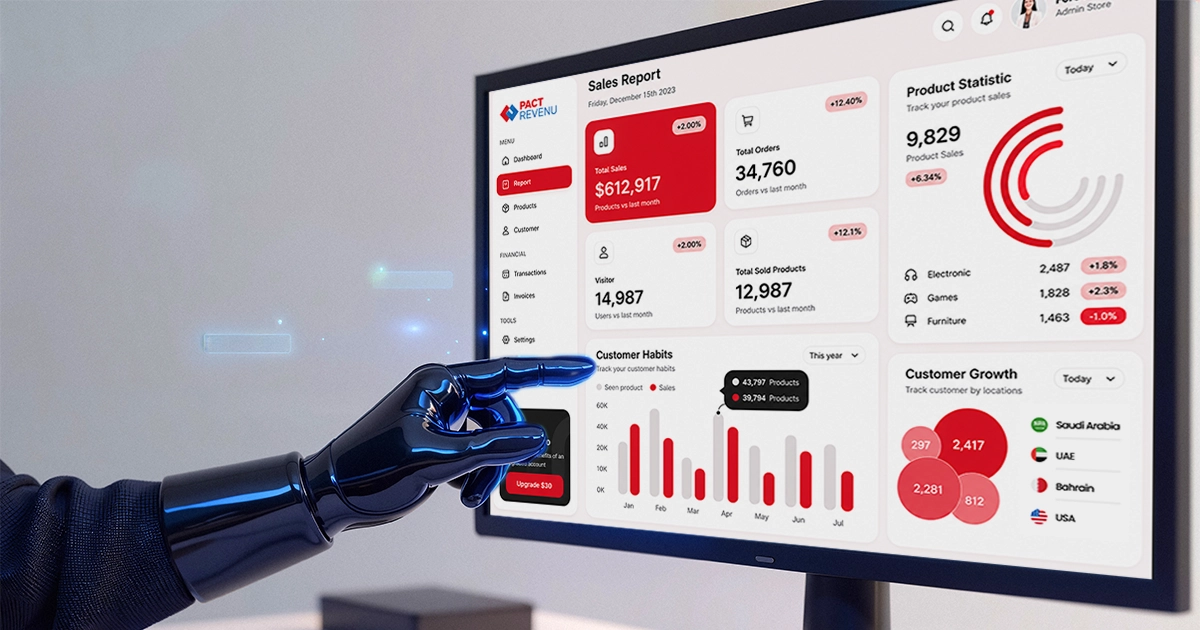
GCC companies are moving from basic digitization to decision-ready enterprise systems.
Most ERP platforms already store the data business leaders need: invoices, purchase orders, inventory movement, branch sales, budgets, supplier records, customer records, payment history, and finance reports. The challenge is that many teams still review this data manually, wait for late reports, and respond to exceptions after cost, cash flow, or delivery has already been affected.
This is where AI automation inside ERP becomes valuable.
The goal is not to replace finance or operations teams. The goal is to help them see important signals earlier, reduce repetitive manual review, route approvals more intelligently, detect exceptions faster, and support better decisions from the data already inside the business.
For GCC organizations in Saudi Arabia, Bahrain, the UAE, and the wider region, practical AI automation should begin with real business questions:
- Which approvals are slowing down work?
- Which invoices need extra review?
- Which branches are showing early performance risk?
- Which items may face stock pressure?
- Which budgets are moving outside expected limits?
- Which reports take too long to prepare?
- Which decisions are still being made too late?
The strongest AI use cases are not hype-driven. They are grounded in finance control, operational visibility, workflow discipline, and cleaner reporting.
Key Takeaways
- AI automation inside ERP helps finance and operations teams turn existing system data into alerts, forecasts, summaries, exception flags, and decision support.
- The strongest use cases include approval routing, invoice exception detection, cash flow signals, budget alerts, inventory reorder signals, demand forecasting, branch performance monitoring, and ERP reporting automation.
- AI works best when ERP data is clean, workflows are structured, and business owners agree on what each alert or recommendation should mean.
- AI should support human decision-making, especially in finance, procurement, payroll, compliance, and high-value transactions.
- Aramis Solutions helps GCC businesses apply AI through Artificial Intelligence services, PACT ERP, Custom Development, system integration, dashboards, and practical automation planning.
Summary
AI ERP automation helps GCC businesses use ERP data more intelligently.
Instead of waiting for month-end reports, finance teams can receive earlier signals about budget pressure, invoice exceptions, cash flow risk, and unusual transactions. Instead of reacting to stockouts, delayed procurement, weak branch performance, or delivery problems, operations teams can use AI-supported alerts and forecasts to act earlier.
The value comes from practical decision support. AI can summarize reports, identify unusual patterns, forecast demand, recommend escalation, and highlight risks. But it should not operate without governance. Sensitive finance and operations decisions still need human review, clear ownership, auditability, and strong data quality.
Aramis Solutions helps businesses connect AI with ERP workflows in a way that supports real business operations, not just dashboard demonstrations.
How Can AI Automation Improve ERP Finance and Operations?
AI ERP automation helps GCC businesses improve finance and operations by using system data to support approvals, forecasting, reporting, inventory signals, budget alerts, and risk detection. It works best when ERP data is clean, workflows are structured, and automation supports business decisions instead of replacing human oversight.
Founder’s Perspective: AI Should Start With Business Pain, Not Technology Excitement
In many enterprise technology projects, AI discussions begin with tools.
That is usually the wrong starting point.
For a GCC business, the better starting point is operational pain. A CFO may be losing time preparing reports. A COO may not see stock or branch issues early enough. A procurement team may be chasing approvals manually. A finance manager may be reviewing too many invoices line by line. A business owner may not know which branch, project, or department is creating margin pressure until the month has already closed.
These are the situations where AI can create practical value.
Before adding AI to ERP, leadership should ask:
- What decision is currently too slow?
- What report takes too long to prepare?
- What exception is missed until it becomes costly?
- Which approvals need better routing or escalation?
- Which finance risks need earlier visibility?
- Which operations signals are already inside ERP but not being used?
- Is the data clean enough to support reliable recommendations?
- Who will review and approve AI-supported actions?
AI inside ERP is not about replacing management judgment. It is about helping management see the right signals earlier.
Why ERP Systems Need Better Decision Support
ERP systems hold valuable business data, but leaders often receive insights too late.
Traditional ERP systems are designed to record transactions and structure business workflows. They manage finance, procurement, inventory, sales, operations, and reporting. But in many companies, decision-making still depends on people manually finding patterns inside reports.
A CFO may only see budget variance after month-end. A procurement manager may notice supplier delays after a project has already been affected. A branch manager may see weak stock movement after sales have dropped. A COO may only understand a fulfillment problem after customer complaints begin.
AI helps move ERP from record-keeping toward decision support.
This direction also fits the wider regional move toward data-driven business and government modernization. Saudi Arabia’s National Strategy for Data and AI, the UAE’s Strategy for Artificial Intelligence, and Bahrain’s ICT and Digital Economy Strategy all show how data, automation, AI, and digital capability are becoming part of regional economic priorities.
For businesses, the practical message is clear: ERP already contains decision signals. AI can help surface them earlier when the data is reliable and the workflow is controlled.
Finance Workflows AI Can Improve
AI can improve ERP finance workflows by helping teams route approvals, detect invoice exceptions, monitor cash flow, flag budget pressure, identify risk patterns, and automate management reporting.
Finance is one of the best places to begin because ERP finance data is usually structured and linked to approvals, invoices, payments, budgets, suppliers, cost centres, and reports.
Approval Routing
Approval routing is often one of the first areas where automation can create visible improvement.
Many finance and procurement requests move slowly because they depend on manual follow-up. A purchase request may wait for the wrong approver. An invoice may sit without escalation. An expense may be delayed because the system does not recognize urgency, amount, project, or budget impact.
AI can support approval workflows by:
- Identifying urgent requests
- Highlighting unusual approval patterns
- Recommending escalation paths
- Summarizing requests for approvers
- Flagging requests outside normal behaviour
- Prioritizing approvals linked to project or delivery impact
AI should not approve high-risk transactions alone. It should help decision-makers understand which approvals require attention and why.
For businesses in Saudi Arabia, Bahrain, and the UAE with several departments, branches, or project teams, this can reduce delays without weakening control.
Cash Flow Signals
Cash flow visibility is critical for CFOs and business owners.
ERP already contains receivables, payables, invoices, due dates, customer payment history, supplier commitments, bank-related entries, and branch revenue. AI can analyze these patterns and alert finance teams to possible cash pressure before it becomes urgent.
Useful cash flow signals may include:
- Customers likely to pay late
- Supplier payments creating pressure in a specific week
- Branch revenue below expected patterns
- Receivables aging risk
- Payment delays by customer segment
- Unusual movement in cash commitments
- Collection priorities for finance teams
AI-supported cash flow visibility should be treated as a planning aid, not a guaranteed forecast. Finance leadership still needs judgment, especially when market conditions, customer behaviour, project delays, or payment cycles change.
Budget Alerts
Budget alerts help teams detect variance before month-end reporting.
AI can compare budgets with actual spend, committed purchase orders, department behaviour, project activity, branch trends, and historical patterns. When costs begin moving outside expected limits, the system can alert finance and operations teams earlier.
This is useful for businesses with:
- Multiple cost centres
- Project-based operations
- Branch structures
- Department budgets
- Procurement-heavy workflows
- Construction or service delivery cost tracking
- Inventory or logistics cost pressure
The value is early visibility.
Instead of discovering overspending after the month closes, leadership can ask the right questions while there is still time to act.
Invoice Exception Detection
Invoice exception detection is a practical AI use case for finance teams.
Growing businesses process a large number of supplier invoices, purchase orders, expense claims, tax values, and payment requests. Manual review becomes time-consuming and increases the risk of missing something unusual.
AI can help flag:
- Duplicate invoices
- Unusual supplier amounts
- Missing purchase orders
- Tax inconsistencies
- Invoices outside normal approval patterns
- Supplier changes near payment dates
- High-value invoices needing additional review
- Expense claims outside policy
This does not mean every invoice should be blocked.
The stronger approach is risk-based review. AI helps identify what looks unusual so finance teams can spend more time on exceptions and less time checking routine items.
Risk and Compliance Flags
ERP systems support finance, tax, procurement, payroll, supplier records, customer records, approval evidence, and audit trails. This makes risk detection an important automation opportunity.
AI can help identify patterns such as:
- Unusual payment timing
- Repeated approval overrides
- Missing supporting documents
- High-value supplier changes
- Budget exceptions
- Irregular purchase activity
- Unusual user behaviour
- Transactions without expected approvals
The NIST AI Risk Management Framework is a useful reference for businesses thinking about AI governance, risk, and monitoring. The OECD AI Principles also reinforce the importance of trustworthy, human-centred, transparent, and accountable AI use.
For GCC businesses, this means AI should be governed carefully. Finance and compliance-related automation should include human review, clear responsibility, and auditability.
Management Reporting
Management reporting is one of the most useful and low-friction AI opportunities in ERP.
Many CFOs and department heads spend too much time preparing repetitive summaries, explaining variances, and converting system reports into board-level or management-level narratives.
AI can help:
- Summarize financial performance
- Explain variance patterns
- Prepare draft management commentary
- Highlight unusual movement
- Compare branches or departments
- Identify questions for leadership review
- Convert complex reports into clearer language
- Support weekly or monthly decision meetings
Finance teams should still validate final numbers and narratives. But AI can reduce the preparation burden and make reports easier for non-finance leaders to understand.
This is where ERP reporting automation becomes highly practical.
Operations Workflows AI Can Improve
AI can improve operations by detecting inventory risk, forecasting demand, monitoring branch performance, flagging procurement issues, improving fulfillment visibility, and identifying maintenance or asset signals.
Operations teams often deal with fast-moving data. Inventory, procurement, delivery, service requests, assets, branches, and customer commitments can change daily. AI can help operations teams see movement earlier and act before small problems become expensive.
Inventory Reorder Signals
Inventory reorder signals help companies reduce stockouts and overstocking.
AI can review sales history, usage trends, seasonality, lead times, supplier reliability, current stock movement, and branch-level demand. From there, it can suggest which items may need reorder attention.
This is useful for:
- Retail businesses
- Distribution companies
- Construction suppliers
- Automotive dealerships
- Equipment rental businesses
- Facility management teams
- Manufacturing operations
- Multi-branch companies
A basic ERP may show current stock. AI-supported analysis can help identify where stock is likely to become a problem.
That difference matters.
Demand Forecasting
Demand forecasting helps companies estimate future sales, consumption, or service needs.
AI can use ERP history, branch activity, customer orders, seasonal movement, past demand changes, and supplier patterns to support forecasting.
Forecasting can help businesses plan:
- Inventory
- Procurement
- Staffing
- Cash flow
- Warehouse capacity
- Delivery schedules
- Sales campaigns
- Branch targets
Forecasting should always be treated as decision support. Market conditions, promotions, economic changes, supplier issues, and project-specific events still need human interpretation.
AI can help leadership ask better questions. It should not create false confidence.
Branch Performance Alerts
Many GCC businesses operate across multiple branches, entities, cities, or countries.
A leadership team may need to know which branch is underperforming, where inventory movement is slow, where cost is rising, or where service levels are declining.
AI can help detect branch-level changes such as:
- Revenue below normal pattern
- Stock movement slowing down
- Cost increasing unusually
- Service requests rising
- Delivery delays increasing
- Sales conversion dropping
- Inventory mismatch by location
- Performance gaps compared with similar branches
This helps leaders move from late reporting to earlier investigation.
A branch issue may be caused by stock, staffing, pricing, demand, procurement, service delays, or data errors. AI can help identify where to look first.
Procurement Exceptions
Procurement is another strong use case because it connects cost, supplier performance, approvals, inventory, projects, and delivery.
AI can help flag procurement exceptions such as:
- Purchase price increases
- Supplier delivery delays
- Repeated urgent purchases
- Purchase orders outside normal patterns
- Missing approvals
- Supplier concentration risk
- Budget pressure from procurement activity
- Delayed approval chains
For businesses with projects, sites, warehouses, or branches, procurement exceptions can affect delivery and cash flow quickly.
AI should not replace procurement judgment. But it can help teams identify where attention is needed before a delay becomes operational pressure.
Delivery and Fulfillment Visibility
Delivery and fulfillment delays can damage customer experience and internal coordination.
AI can review order status, stock availability, delivery schedules, branch readiness, customer commitments, and fulfillment history to identify potential delays.
This helps operations teams answer:
- Which orders are at risk?
- Which branch cannot fulfill on time?
- Which item may delay delivery?
- Which customer commitment needs attention?
- Which supplier delay may affect fulfillment?
- Where should the team intervene first?
Instead of waiting for customers to complain, operations teams can act earlier and communicate more clearly.
This is particularly useful for distribution, retail, logistics, equipment rental, service, and project-based businesses.
Maintenance and Asset Signals
Companies that rely on equipment, fleet, facilities, production assets, or service infrastructure can use AI to identify asset-related risk earlier.
AI can review:
- Repeated breakdowns
- Maintenance cost patterns
- Asset usage history
- Downtime frequency
- Service intervals
- Repair delays
- Equipment availability
- Branch or site-level asset movement
This can support preventive maintenance planning, asset utilization, and cost control.
For construction, facility management, logistics, manufacturing, and equipment rental businesses, earlier maintenance signals can reduce disruption and protect revenue.
AI Automation vs Basic ERP Workflow Automation
Basic ERP workflow automation follows fixed rules, while AI automation uses patterns, historical data, exceptions, and predictions to recommend actions, highlight risks, and support better decisions.
Both are useful.
Basic workflow automation can route approvals, send reminders, trigger notifications, and enforce process rules. For example, an invoice above a certain value may go to a finance manager. A purchase request from a specific department may follow a defined approval path.
AI adds another layer.
It can detect that an invoice is unusual for a supplier, that a budget is likely to exceed its limit, that a branch is showing early signs of performance decline, or that a stock item may become unavailable based on movement patterns.
The safest approach is controlled automation.
AI can recommend, summarize, classify, forecast, and alert, while humans remain responsible for approvals, policy exceptions, sensitive finance decisions, and final business judgment.
Data Readiness for AI in ERP Systems
AI in ERP depends on clean, consistent, governed data. If customer, supplier, inventory, finance, branch, and approval records are incomplete, AI outputs will be unreliable.
Before launching AI automation, businesses should review the quality of their ERP data.
Important areas include:
- Customer records
- Supplier records
- Item and inventory data
- Branch and entity structures
- Cost centres
- Chart of accounts
- Invoice history
- Purchase orders
- Sales orders
- Payment records
- Stock movement
- Approval history
- User roles
- Asset records
- Reporting definitions
If supplier names are duplicated, cost centres are inconsistent, stock movement is incomplete, or branch data is outdated, AI will produce weak recommendations.
A business should not begin with an AI dashboard demo.
It should begin with data readiness, workflow clarity, and governance.
This is why Aramis Solutions connects AI planning with ERP implementation, reporting, and custom development. AI becomes useful when the ERP foundation is reliable.
Responsible AI and Human Oversight
Responsible AI is especially important when automation touches finance, procurement, payroll, compliance, supplier records, customer data, and operational decisions.
GCC businesses should define what AI can and cannot do.
AI may be allowed to:
- Flag exceptions
- Summarize reports
- Recommend escalation
- Forecast demand
- Highlight possible risk
- Prepare draft commentary
- Prioritize review items
AI should not be left alone to:
- Approve high-value payments
- Change supplier bank details
- Override finance controls
- Make payroll decisions
- Remove audit requirements
- Approve policy exceptions
- Take action without traceability
The business should define:
- Who owns AI recommendations
- Who reviews exceptions
- Who can override AI outputs
- How outputs are logged
- How accuracy is checked
- How users are trained
- How sensitive data is protected
The goal is not to make AI invisible. The goal is to make AI useful, explainable, governed, and safe enough for real business operations.
AI ERP Automation Use Cases for Finance and Operations
| Business Area | AI Use Case | Practical Value |
|---|---|---|
| Finance approvals | Prioritize and summarize approval requests | Reduces approval delays |
| Cash flow | Identify possible cash pressure from receivables and payables | Gives CFOs earlier visibility |
| Budget control | Flag departments, branches, or projects moving beyond expected limits | Supports faster cost control |
| Invoice review | Detect duplicate, unusual, or incomplete invoices | Reduces manual checking burden |
| Risk monitoring | Highlight unusual transactions or approval patterns | Supports better governance |
| Management reporting | Summarize financial and operational performance | Saves reporting preparation time |
| Inventory | Recommend reorder attention based on movement and lead time | Reduces stockout and overstock risk |
| Demand planning | Forecast sales, consumption, or service needs | Improves operational planning |
| Branch performance | Detect underperformance or unusual branch patterns | Helps leadership investigate earlier |
| Procurement | Flag supplier delays, price changes, or abnormal purchase activity | Improves procurement control |
| Fulfillment | Identify orders or deliveries at risk | Supports better customer communication |
| Assets | Detect repeated downtime or maintenance signals | Reduces disruption and asset cost pressure |
AI ERP Automation Checklist for GCC Businesses
Before implementing AI automation inside ERP, GCC businesses should prepare use cases, ERP data, workflow rules, approval ownership, reporting requirements, governance controls, and human review.
| Readiness Area | What to Prepare | Why It Matters |
|---|---|---|
| Use cases | Finance and operations problems AI should support | Keeps AI tied to business value |
| ERP data | Clean finance, inventory, procurement, sales, branch, and supplier data | Improves recommendation quality |
| Workflow rules | Approval paths, escalation rules, exception definitions | Makes automation practical |
| Reporting needs | CFO, COO, branch, procurement, and management dashboards | Supports decision-making |
| Governance | Ownership, access, logs, overrides, monitoring | Reduces AI risk |
| Human review | Sensitive decisions, approvals, exceptions, and policy matters | Keeps accountability clear |
| Integrations | ERP, reporting tools, dashboards, custom workflows | Prevents disconnected automation |
| Rollout plan | Start with measurable use cases before expanding | Reduces implementation risk |
| Training | Teach users how to interpret AI outputs | Improves adoption and trust |
This checklist reduces risk because AI works best when the business defines what the system should support before implementation begins.
Where GCC Businesses Should Start
GCC businesses should start with AI use cases that have clear data, repeated manual effort, and measurable business value.
Good starting points include:
- Approval routing
- Invoice exceptions
- Budget alerts
- Cash flow signals
- Inventory reorder signals
- Branch performance alerts
- Procurement exceptions
- ERP report summaries
These use cases are practical because they do not require the business to transform everything at once.
They allow finance and operations teams to test AI in controlled areas, measure results, improve data quality, and expand gradually.
A phased roadmap may look like this:
- Review ERP data quality and workflow maturity
- Select two to three high-value use cases
- Define alert rules, ownership, and human review
- Build dashboards or automation layers
- Test recommendations against historical records
- Train users on how to interpret outputs
- Monitor accuracy and business impact
- Expand into more advanced forecasting and optimization
This approach keeps AI realistic and useful.
How Aramis Solutions Supports AI Automation in Enterprise Systems
Aramis Solutions supports AI automation by assessing ERP workflows, identifying finance and operations use cases, preparing data, building integrations, configuring dashboards, and keeping human oversight in the process.
Aramis works with GCC businesses as a consultant and implementation partner across AI, ERP, custom development, cybersecurity, Microsoft 365, HRMS, and enterprise systems.
The process begins by identifying where finance and operations lose time:
- Slow approvals
- Delayed reporting
- Budget surprises
- Stock issues
- Procurement exceptions
- Branch performance gaps
- Manual report preparation
- Repeated follow-ups
- Limited visibility before month-end
For businesses using PACT ERP, Aramis Solutions can help identify where AI can support finance, inventory, procurement, sales, reporting, and operations workflows.
Through Artificial Intelligence services, Aramis helps companies define practical AI use cases and apply them with governance.
Through Custom Development, Aramis can support custom dashboards, workflow extensions, alerts, integrations, and automation layers where standard ERP workflows need additional flexibility.
Through Cyber Security services, Aramis helps businesses think about access, data protection, governance, and system risk before automation is expanded.
The goal is not to force AI into every process.
The goal is to improve decisions where ERP already contains useful data.
To review AI opportunities inside your ERP environment, contact Aramis Solutions for a consultation.
FAQs
AI ERP automation uses ERP data to support approvals, forecasts, alerts, reporting, exception detection, and decision recommendations. It helps finance and operations teams identify budget pressure, cash flow signals, invoice exceptions, stock risks, branch performance issues, and reporting summaries while keeping human review for important decisions.
AI can improve ERP finance workflows by routing approvals, detecting invoice exceptions, identifying budget variance, forecasting cash flow, summarizing reports, and flagging risk patterns. It helps CFOs and finance teams review important issues earlier. It does not remove finance accountability; it gives teams better signals from ERP data.
AI can improve operations and inventory planning by analyzing stock movement, sales history, lead times, branch performance, procurement delays, demand patterns, and fulfillment activity. This helps teams identify reorder needs, demand changes, asset issues, and delivery risks earlier.
AI automation needs clean master data, reliable transaction history, structured workflows, approval records, supplier data, customer data, inventory movement, branch data, finance records, and reporting definitions. If ERP data is incomplete or inconsistent, AI recommendations may be weak.
Yes. Basic workflow automation follows fixed rules, such as routing approvals by amount or department. AI automation uses data patterns, historical behaviour, exceptions, and predictions to recommend actions or flag risk. Businesses can combine both: rules for process control and AI for smarter alerts, forecasts, and summaries.
GCC businesses should start with ERP processes that have clear data, repeated manual effort, and measurable value. Good starting points include approval routing, invoice exceptions, budget alerts, cash flow signals, inventory reorder signals, demand forecasting, branch performance alerts, and ERP reporting automation.
No. AI should support finance and operations teams, not replace them. It can identify patterns, summarize reports, recommend escalation, and flag exceptions. Human teams should remain responsible for approvals, policy decisions, sensitive transactions, financial judgment, and final business action.
Aramis Solutions supports AI automation by assessing ERP workflows, identifying finance and operations use cases, reviewing data readiness, building integrations, configuring dashboards, designing custom automation layers, and keeping human oversight in the process. The team helps GCC businesses apply AI where it improves decisions, reporting, forecasting, and operational control.
Final Thoughts
AI ERP automation helps GCC businesses move from delayed reporting and manual reviews toward earlier alerts, better forecasts, faster approvals, and stronger finance and operations visibility.
ERP already contains many of the signals business leaders need. The problem is that those signals are often buried inside transactions, approvals, reports, and spreadsheets. AI helps surface those signals sooner when the business has clean data, structured workflows, and clear governance.
For finance teams, AI can support cash flow visibility, budget alerts, invoice exceptions, approval routing, and management reporting. For operations teams, it can support inventory planning, procurement alerts, demand forecasting, branch performance, fulfillment visibility, and asset monitoring.
The strongest AI roadmap is practical. Start with business pain, clean the data, define ownership, keep human review in place, and expand gradually.
Aramis Solutions helps GCC businesses design AI automation that fits real ERP workflows and operational priorities across Saudi Arabia, Bahrain, the UAE, and the wider region.
Related Aramis Solutions Resources
For deeper reading before planning AI automation inside ERP, explore these related resources:
- Artificial Intelligence Services
- PACT ERP Solutions
- Custom Development Services
- Cyber Security Services
- How AI Automation Is Changing ERP, CRM, and HRMS Workflows in the GCC
- Why AI Initiatives Fail Before Reaching Production
- Predictive Analytics Use Cases for GCC ROI
- Automate ERP Workflows for Faster ROI
- ERP, CRM and HRMS Integration in GCC Enterprises
- Legacy System Modernization in the GCC
- How to Choose an Enterprise Technology Partner in the GCC