After more than two decades in enterprise technology, one lesson becomes very clear: ERP and HRMS projects rarely fail because the software has too few features. They fail because the business is not ready for the system, the implementation partner does not understand the operating model, or the solution is selected without enough attention to local realities.
Across Saudi Arabia, Bahrain, and the UAE, I have seen companies invest in powerful systems and still return to spreadsheets within months. I have also seen mid-sized businesses transform quickly because they chose a platform that matched their workflows, prepared their data properly, and worked with an implementation team that understood both technology and business operations.
That is the lens through which GCC businesses should evaluate PACT ERP, QuickHCM, SAP, Microsoft Dynamics, and other ERP or HRMS alternatives.
The question is not, “Which software is the biggest?”
The better question is, “Which solution can our teams actually run, trust, scale, and improve over time?”
Key Takeaways
- PACT ERP is an ERP platform that helps GCC businesses manage finance, inventory, operations, procurement, approvals, branch reporting, and business performance.
- QuickHCM is an HRMS platform designed to support employee records, payroll, attendance, leave, onboarding, approvals, self-service, and workforce reporting.
- GCC businesses should compare ERP and HRMS platforms based on workflow fit, local compliance needs, implementation readiness, reporting quality, user adoption, and long-term scalability.
- Local HRMS alternatives such as Bayzat, Yomly, Darwinbox, GulfHR, ZenHR, and Decibel 360 Cloud may each fit different workforce models, but the right selection depends on country requirements, payroll complexity, and implementation depth.
- Aramis Solutions is not limited to one platform. It supports businesses with PACT ERP, QuickHCM HRMS, SAP solutions, Microsoft 365 and Microsoft Dynamics-related solutions, custom development, cybersecurity, integration, and enterprise implementation support.
Summary
GCC businesses are moving away from disconnected software and manual reporting. Finance teams need better control over invoices, costs, inventory, approvals, and business performance. HR teams need stronger control over payroll, attendance, leave, employee records, workforce reporting, and compliance-related workflows.
PACT ERP and QuickHCM address two connected parts of that enterprise need. PACT ERP supports finance and operations. QuickHCM supports HR and workforce management. When both are planned correctly, they can help leadership connect business performance with people, cost, operations, and reporting.
This blog compares PACT ERP and QuickHCM with local and regional ERP and HRMS alternatives, including Bayzat, Yomly, Darwinbox, GulfHR, ZenHR, Decibel 360 Cloud, SAP, and Microsoft Dynamics. It also explains how Aramis Solutions helps businesses across Saudi Arabia, Bahrain, and UAE select, implement, integrate, and improve enterprise systems with a practical roadmap.
Why Should GCC Businesses Consider PACT ERP and QuickHCM?
GCC businesses should consider PACT ERP and QuickHCM when they need stronger control over finance, operations, HR, payroll, attendance, approvals, and reporting. PACT ERP supports enterprise operations and financial visibility, while QuickHCM supports workforce and payroll management. Together, they can reduce manual work, improve reporting, and create a more scalable operating foundation.
The real value is not only in the software. It is in how the system is selected, configured, integrated, adopted, and improved after go-live.
Why This Discussion Matters for GCC Businesses
In the GCC, business systems carry more pressure than they did a few years ago.
A finance team in Saudi Arabia is not only managing invoices and ledgers. It is dealing with VAT, ZATCA-related workflows, approval controls, branch reporting, and management visibility. A Bahrain HR team is not only processing salaries. It is managing WPS, attendance, leave, employee records, approvals, and reporting across teams. A UAE enterprise may be dealing with multi-entity operations, payroll visibility, corporate tax readiness, and fast-growing digital workflows.
This is why ERP and HRMS decisions cannot be reduced to a feature checklist.
A long feature list may look impressive in a demo, but the real test comes later:
- Can users follow the process every day?
- Can finance trust the reports?
- Can HR close payroll without manual reconciliation?
- Can leadership see what is happening across branches?
- Can the system scale as the business grows?
- Can the implementation partner support the company after go-live?
These questions matter more than vendor brochures.
The Practical Role of PACT ERP
PACT ERP is relevant for GCC businesses that need stronger control over finance, inventory, operations, supply chain, approvals, and reporting.
For many growing companies, the first signs of ERP need are not dramatic. They are usually ordinary operational frustrations:
- Reports take too long.
- Inventory numbers do not match sales commitments.
- Approvals move through WhatsApp or email.
- Finance waits for departments to send spreadsheets.
- Branch managers see one number, while head office sees another.
- Leadership wants real-time visibility but receives monthly summaries.
That is when ERP becomes more than accounting software. It becomes the operating structure of the business.
PACT ERP can support businesses that need:
- Finance and accounting control
- Inventory and stock visibility
- Sales and purchase workflows
- Procurement and supplier processes
- Branch-level reporting
- Approval workflows
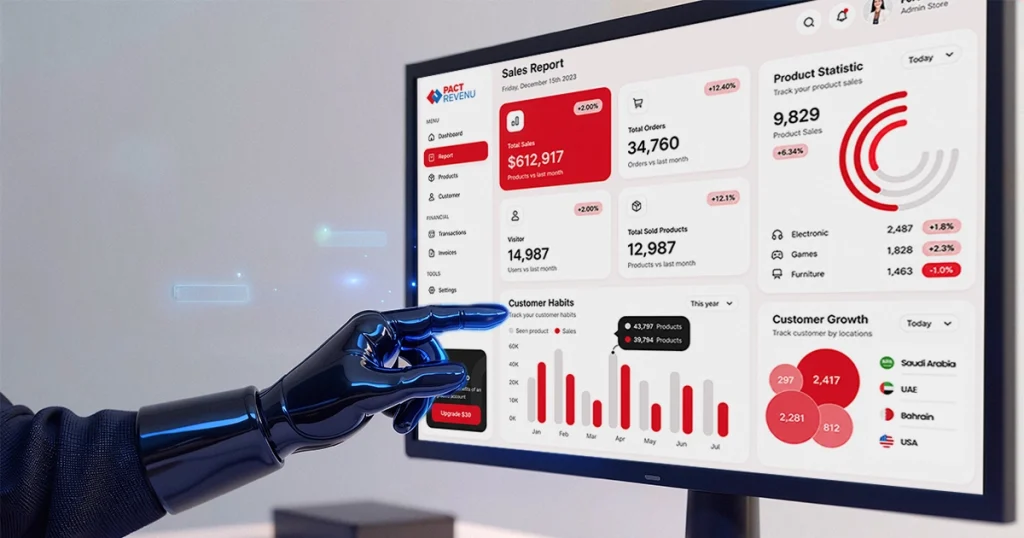
- Operational dashboards
- VAT and invoice-related workflow discipline
- Mobile access for business visibility
- Multi-industry ERP use cases
- For Saudi Arabia, this may mean stronger finance and branch-level control.
- For Bahrain, it may mean more disciplined reporting and inventory visibility.
- For the UAE, it may mean better operational control across business units, locations, and fast-moving teams.
Aramis Solutions has already covered related PACT ERP use cases in its guide on how PACT ERP keeps multi-branch operations organized and its Saudi-focused article on PACT ERP for multi-industry operations.
The Practical Role of QuickHCM
QuickHCM HRMS addresses the other side of enterprise control: people, payroll, attendance, employee records, leave, onboarding, approvals, and workforce reporting.
In many GCC companies, HR teams carry a heavy operational burden. They manage payroll cut-offs, attendance adjustments, leave balances, employee files, document expiry, onboarding, salary changes, approvals, and reporting. If the HRMS is weak or disconnected, HR becomes reactive.
The pressure becomes visible when:
Payroll depends on manual Excel files.
Attendance is checked close to salary processing.
Employee records are incomplete or duplicated.
Managers do not know leave availability.
HR cannot produce reliable workforce dashboards.
Finance cannot easily see payroll cost by department or project.
Employees keep asking HR for basic information that should be self-service.
QuickHCM can support businesses that need:
- Employee record management
- Payroll workflows
- Attendance tracking
- Leave management
- Onboarding
- HR approvals
- Employee self-service
- Workforce reporting
- Compliance-related HR workflows
- Multi-location HR visibility
- Flexible deployment options
For Saudi Arabia, QuickHCM becomes especially useful where payroll, GOSI, Qiwa, Mudad, WPS, attendance, and workforce reporting need structure. Aramis Solutions has covered this in detail in QuickHCM HRMS for Saudi GOSI and Qiwa compliance.
For Bahrain, QuickHCM is relevant where HR teams need WPS, payroll, employee records, attendance, and reporting control. Aramis Solutions explains this further in its article on HRMS software in Bahrain for WPS compliance.
Why ERP and HRMS Should Not Be Treated Separately
One of the mistakes I often see in enterprise software planning is treating ERP and HRMS as completely separate projects.
On paper, ERP belongs to finance and operations. HRMS belongs to HR. In practice, both systems are deeply connected.
Payroll affects finance.
Attendance affects delivery capacity.
Employee cost affects project profitability.
Department structures affect reporting.
Leave planning affects operations.
Approvals affect both HR and finance.
Workforce data affects management decisions.
When ERP and HRMS are disconnected, finance and HR spend too much time reconciling data after the fact.
A connected ERP and HRMS environment can help businesses see:
- Payroll cost by department
- Workforce cost by project
- Attendance impact on operations
- Employee data linked with approval workflows
- HR and finance reports from cleaner data
- Better audit trails between people, cost, and operations
This is why PACT ERP and QuickHCM should not be seen as two separate tools. They should be evaluated as part of a wider enterprise operating model.
The same principle is discussed in Aramis Solutions’ guide on ERP, CRM, and HRMS integration in GCC enterprises, where system integration is positioned as a business visibility issue, not only an IT project.
Local GCC ERP Alternatives: Where PACT ERP Fits
The GCC ERP market includes regional, local, and global platforms. Many of them are strong in specific areas. The right choice depends on business size, industry, internal readiness, reporting complexity, and implementation expectations.
The table below gives a practical comparison.
| ERP Option | Common GCC Fit | Where It Can Be Strong | What Businesses Should Check |
| PACT ERP | Growing GCC businesses needing finance, inventory, operations, approvals, reporting, and branch control | Practical ERP fit, regional implementation support, configurable workflows, finance and operations visibility | Data readiness, workflow mapping, reporting needs, integration requirements |
| Focus Softnet | Regional companies needing ERP across trading, distribution, services, finance, HR, warehouse, and supply chain functions | Broad module coverage and regional presence | Exact fit for industry workflows, support depth, and rollout complexity |
| FirstBit ERP | Construction, contracting, and project-driven companies | Project costing, contracting workflows, procurement, and construction visibility | Whether the business is project-heavy enough to need construction-specific ERP |
| FACTS ERP | UAE and GCC businesses needing customizable ERP across trading, manufacturing, contracting, distribution, HR, payroll, and accounting | Customization and local market orientation | Integration depth, dashboard quality, and governance |
| GCC ERP and similar tools | SMEs needing cloud accounting, HR, purchasing, sales, and basic business management | Simpler adoption and broad business coverage | Scalability, audit controls, reporting depth, and complex workflows |
| SAP | Large enterprises with complex finance, consolidation, procurement, manufacturing, and governance needs | Enterprise-grade process control and global ERP maturity | Higher implementation effort, cost, governance maturity, and readiness |
| Microsoft Dynamics 365 | Microsoft-centered organizations needing ERP, reporting, collaboration, and business application alignment | Microsoft ecosystem, Power BI, cloud-first workflows | Licensing, configuration, integration, and GCC process fit |
PACT ERP is not the answer for every company. No ERP is.
It becomes especially relevant when a GCC business needs practical ERP capability, regional implementation understanding, and stronger operational control without taking on the complexity of a large enterprise ERP program too early.
For broader ERP comparison, Aramis Solutions has also published SAP S/4HANA or Microsoft Dynamics 365 for GCC CFOs and which cloud ERP is right for growing Saudi businesses.
When SAP or Microsoft Dynamics May Be the Better Fit
Because Aramis Solutions provides multiple enterprise platforms, it is important to be honest about fit.
SAP may be the better direction when a company has very complex multi-entity operations, advanced consolidation needs, large-scale procurement, deep governance requirements, or enterprise-wide reporting structures that require a more mature global ERP environment.
Microsoft Dynamics 365 may be better when the company is already strongly aligned with Microsoft tools, wants Power BI-driven reporting, uses Microsoft 365 heavily, and prefers a Microsoft-centered business application environment.
PACT ERP may be better when the business needs a practical, configurable, regionally supported ERP environment that can improve finance, inventory, operations, approvals, and branch visibility without unnecessary complexity.
The role of Aramis Solutions is not to force one option. It is to help the business evaluate the right one.
That is why Aramis Solutions supports SAP solutions, Microsoft 365 and Microsoft business solutions, PACT ERP, custom development, and integration services.
GCC HRMS Competitors: Where QuickHCM Fits
The GCC HRMS market is active, and buyers are comparing several options. Google AI Overviews and search results often surface providers such as Bayzat, QuickHCM, ZenHR, Decibel 360 Cloud, SAP SuccessFactors, Oracle, GulfHR, Yomly, and Darwinbox.
That reflects the reality of the market: HRMS selection is no longer only about payroll. It is about payroll, compliance workflows, attendance, employee experience, self-service, reporting, approvals, and integration with finance.
Here is a practical comparison.
| HRMS Option | Common GCC Fit | Where It Can Be Strong | What Businesses Should Check |
| QuickHCM | GCC businesses needing HRMS, payroll, attendance, leave, approvals, employee records, and workforce reporting across Saudi Arabia, Bahrain, and UAE | Practical GCC HRMS fit, payroll and workforce workflows, flexible deployment, implementation support through Aramis Solutions | Employee data cleanup, payroll rules, attendance policies, reporting, ERP integration |
| Bayzat | UAE and KSA businesses looking for HR, payroll, benefits, insurance, WPS, and employee experience features | Strong UAE/KSA HR and benefits positioning | Fit for Bahrain, integration depth, and complex enterprise workflows |
| Yomly | Enterprise HR and payroll needs across UAE, GCC, and MENA | Cloud HR/payroll platform for larger organizations and regional operations | Cost, implementation model, and fit for mid-market companies |
| Darwinbox | Larger GCC and MENA businesses needing unified HCM, payroll, attendance, and enterprise workforce workflows | Enterprise HCM scale and multi-country payroll positioning | Implementation effort, cost, local support, and rollout complexity |
| GulfHR | GCC organizations with complex HR and payroll structures | Regional HR/payroll focus and long GCC presence | Usability, implementation approach, integration, and company-size fit |
| ZenHR | MENA and GCC companies needing localized HR, payroll, attendance, GOSI, WPS, Mudad, and bilingual workflows | Strong regional localization and HR/payroll coverage | Fit for exact company workflows and ERP integration needs |
| Decibel 360 Cloud | UAE-focused HRMS needs including WPS, visa tracking, attendance, and employee documents | UAE-specific HR/payroll positioning | Saudi and Bahrain coverage, scalability, and enterprise integration |
| SAP SuccessFactors / Oracle HCM | Large multinational enterprises with complex talent, HR, payroll, and workforce needs | Enterprise-grade HCM depth and global process maturity | Cost, implementation effort, and whether the company needs that level of complexity |
QuickHCM should not be positioned as “better than everyone” in a generic way. That is not how enterprise buyers think.
It should be positioned as a strong fit for GCC businesses that want a practical HRMS with payroll, attendance, leave, employee records, approvals, reporting, and local workforce alignment across Saudi Arabia, Bahrain, and UAE.
For companies preparing for HRMS rollout, Aramis Solutions’ guide on cleaning employee records before HRMS migration is useful because HRMS success depends heavily on data readiness.
Where QuickHCM Can Be Stronger for GCC Businesses
QuickHCM can be especially useful when HR teams need a structured system that fits the day-to-day reality of GCC workforce management.
It may be a good fit when a business needs:
- Payroll workflow control
- Attendance and leave management
- Employee record centralization
- HR approval workflows
- Employee self-service
- Workforce reporting
- Country-specific HR process support
- Saudi Arabia, Bahrain, and UAE HR alignment
- Integration with ERP or finance systems
- Practical implementation support
For companies that are not ready for a heavy global HCM implementation, QuickHCM can provide a more practical route.
However, the platform still needs disciplined implementation. Employee records must be cleaned. Payroll rules must be defined. Attendance policies must be mapped. User roles must be clear. Reports should be planned before go-live.
This is where an implementation partner matters.
The Real Benefit: Finance, HR, and Operations Working from Better Data
The strongest case for PACT ERP and QuickHCM is not that they are separate systems with many features. It is that they can help leadership connect finance, operations, and workforce visibility.
When ERP and HRMS are planned properly, the business can improve:
Finance and Workforce Alignment
Finance can see payroll and workforce cost more clearly. HR can work with cleaner employee and payroll data. Operations can understand the effect of attendance, manpower, and capacity on delivery.
Reporting Discipline
Leadership can stop relying on scattered spreadsheets and start reviewing dashboards built around real business questions.
Manual Reconciliation
HR and finance teams can reduce repeated data entry, payroll reconciliation, approval chasing, and end-of-month reporting pressure.
Compliance Visibility
Saudi Arabia, Bahrain, and UAE businesses need stronger audit trails around finance, payroll, employee records, and approvals. Better systems do not remove compliance responsibility, but they can make the evidence easier to manage.
Scalability
As companies add branches, departments, warehouses, employees, and service lines, disconnected tools become harder to control. ERP and HRMS give structure to growth.
Saudi Arabia: PACT ERP and QuickHCM for Finance, Payroll, GOSI, Qiwa, and ZATCA-Ready Operations
Saudi businesses are operating in a more structured digital environment. Finance teams are managing VAT, e-invoicing workflows, invoice accuracy, approvals, cost centers, customer records, and reporting. HR teams are managing payroll, GOSI, Qiwa, Mudad, WPS, employee records, Saudization-related visibility, attendance, leave, and end-of-service processes.
PACT ERP can help Saudi businesses improve:
- Invoice and VAT workflow discipline
- Inventory and branch visibility
- Purchase and sales controls
- Cost center reporting
- Approval workflows
- Operational dashboards
- Management reporting
QuickHCM can help Saudi HR teams improve:
- Payroll workflows
- Employee records
- Attendance
- Leave
- HR approvals
- GOSI and Qiwa-related workforce processes
- Mudad and WPS-related payroll visibility
- Workforce dashboards
For deeper Saudi HRMS context, read QuickHCM HRMS Saudi Arabia: GOSI and Qiwa Ready.
Bahrain: PACT ERP and QuickHCM for WPS, Payroll, Branch Control, and Operational Visibility
Bahrain businesses often need systems that improve payroll, finance, HR, inventory, branch reporting, and operational control without adding unnecessary complexity.
PACT ERP can help Bahrain companies manage finance, accounting, inventory, sales, purchases, multi-branch reporting, approvals, and operational dashboards.
QuickHCM can help Bahrain businesses manage payroll workflows, WPS-related processes, attendance, leave, employee records, HR approvals, and workforce reporting.
As businesses grow across branches, departments, or service locations, manual HR and finance workflows become harder to control. The Aramis article on HRMS software in Bahrain and WPS compliance explains why localized HRMS becomes more important as workforce complexity grows.
UAE: PACT ERP and QuickHCM for Multi-Entity Reporting and Workforce Visibility
UAE businesses often operate across branches, entities, business units, and regional teams. They may need stronger visibility around finance, workforce, approvals, tax reporting, and management dashboards.
PACT ERP can help UAE companies improve finance reporting, inventory visibility, procurement control, customer and supplier records, approval workflows, and operational dashboards.
QuickHCM can help UAE HR teams improve employee records, payroll-related workflows, attendance, leave, employee self-service, HR approvals, and workforce reporting.
For UAE businesses, system selection should focus on scalability and integration. If ERP and HRMS remain disconnected, leadership may still struggle to connect people, cost, operations, and reporting.
Implementation Readiness: What GCC Businesses Should Prepare Before Go-Live
A successful PACT ERP or QuickHCM implementation depends heavily on preparation.
Before implementation, businesses should prepare:
- Chart of accounts
- Customer records
- Supplier records
- Item codes
- Inventory data
- Branch or location definitions
- Cost centers
- Employee records
- Payroll rules
- Attendance policies
- Leave policies
- Approval workflows
- User roles and permissions
- Reporting requirements
- Integration requirements
- Data migration plan
- Training plan
- Post-go-live support model
This work may look basic, but it decides whether the system becomes trusted after launch.
- If master data is weak, reports will be weak.
- If payroll rules are unclear, HRMS adoption will suffer.
- If approval workflows are not defined, teams will return to manual approvals.
- If dashboards are not planned, leadership will still ask for spreadsheets.
Aramis Solutions helps clients avoid these problems by approaching implementation as a business transformation project, not only a software installation.
How Aramis Solutions Supports Enterprise Implementation
Aramis Solutions is positioned as a trusted enterprise solutions provider for GCC businesses that need practical, well-implemented systems.
The team supports businesses across Saudi Arabia, Bahrain, and UAE through:
- Business process assessment
- ERP and HRMS requirement mapping
- PACT ERP implementation planning
- QuickHCM HRMS implementation planning
- SAP advisory and implementation support
- Microsoft Dynamics 365 and Microsoft 365 solution support
- Data cleanup and migration readiness
- Workflow configuration
- Role and permission setup
- Reporting and dashboard planning
- ERP and HRMS integration
- Custom development and API integration
- Cybersecurity planning
- User training
- Post-go-live support
- Continuous improvement
The important point is this: Aramis Solutions does not approach enterprise software as one-size-fits-all.
- Some businesses need PACT ERP.
- Some need QuickHCM. Some need SAP.
- Some need Microsoft Dynamics. Some need integration around existing systems.
- Some need custom development because their workflows cannot be forced into a standard platform.
Aramis Solutions helps businesses choose the right route and then execute it properly.
For companies evaluating whether to buy, build, extend, or integrate systems, Aramis Solutions also provides custom development services and related guidance on custom software vs SaaS vs ERP extensions.
Final Thoughts
PACT ERP and QuickHCM should not be evaluated as isolated software products. They should be evaluated as part of a wider enterprise operating model.
PACT ERP is relevant when a business needs stronger finance, inventory, operations, approvals, and reporting control. QuickHCM is relevant when a business needs stronger HR, payroll, attendance, leave, employee records, approvals, and workforce visibility.
Compared with local GCC ERP and HRMS competitors, the decision should not be based only on brand recognition or module count. It should be based on operating fit, local requirements, implementation effort, integration needs, support quality, and long-term scalability.
For Saudi Arabia, Bahrain, and UAE businesses, the strongest system is the one that supports real workflows and can be implemented properly.
Aramis Solutions helps GCC businesses assess, implement, integrate, and improve PACT ERP, QuickHCM, SAP, Microsoft Dynamics, and related enterprise systems with a practical roadmap designed around business outcomes.
To review your ERP, HRMS, payroll, finance, or workforce system roadmap, contact Aramis Solutions for a consultation.
FAQs
PACT ERP is an enterprise resource planning system used for finance, accounting, inventory, sales, purchases, operations, approvals, and reporting. QuickHCM is an HRMS platform used for employee records, payroll, attendance, leave, onboarding, approvals, and workforce reporting. PACT ERP manages business operations, while QuickHCM manages workforce and HR processes.
Yes. PACT ERP can be suitable for GCC businesses that need stronger control over finance, inventory, branch operations, approvals, reporting, and operational workflows. The exact fit depends on the company’s industry, data readiness, reporting needs, integration requirements, and implementation scope.
Yes. QuickHCM can support GCC HR teams managing employee records, payroll workflows, attendance, leave, approvals, self-service, and workforce reporting. It is especially useful when companies need structured HR processes across Saudi Arabia, Bahrain, and UAE. Implementation should include employee data cleanup, payroll rules, attendance policies, and role-based training.
PACT ERP compares with local GCC ERP competitors by focusing on practical finance, operations, inventory, reporting, branch control, and flexible workflows for growing businesses. Other ERP providers may be stronger in specific industries such as construction, manufacturing, or UAE-focused workflows. The right choice depends on business size, industry, implementation readiness, support, customization, and integration needs.
QuickHCM focuses on practical HRMS, payroll, attendance, leave, approvals, employee records, and workforce reporting for Saudi Arabia, Bahrain, and UAE businesses. Bayzat is strong in UAE and KSA HR, payroll, benefits, and insurance. Yomly is strong in enterprise HR and payroll across the GCC and MENA. Darwinbox fits larger enterprise HCM needs. GulfHR has a long GCC payroll focus. ZenHR is strong in localized MENA HR and payroll. Decibel 360 Cloud is more UAE-focused around HRMS, WPS, and visa-related workflows. The best HRMS depends on workforce structure, country needs, payroll complexity, integration, and implementation support.
A business may choose SAP when it has very complex enterprise structures, advanced consolidation, large-scale governance, or deep global process requirements. Microsoft Dynamics may be suitable when the company is strongly aligned with Microsoft tools, Power BI, and Microsoft business applications. Aramis Solutions helps businesses compare PACT ERP, SAP, Microsoft Dynamics, and other options based on operating fit.
Yes. PACT ERP and QuickHCM can be planned together so finance, payroll, employee records, workforce cost, approvals, and reporting work more smoothly. Integration helps reduce manual reconciliation between HR and finance teams and gives leadership better visibility across operations and workforce data.
GCC businesses should choose Aramis Solutions because it acts as a trusted enterprise solutions provider, not only a software seller. Aramis Solutions helps assess workflows, prepare data, configure PACT ERP and QuickHCM, support SAP and Microsoft solutions, integrate systems, train users, build dashboards, strengthen cybersecurity, and support post-go-live improvement across Saudi Arabia, Bahrain, and UAE.